
29029: A System Built and Tested
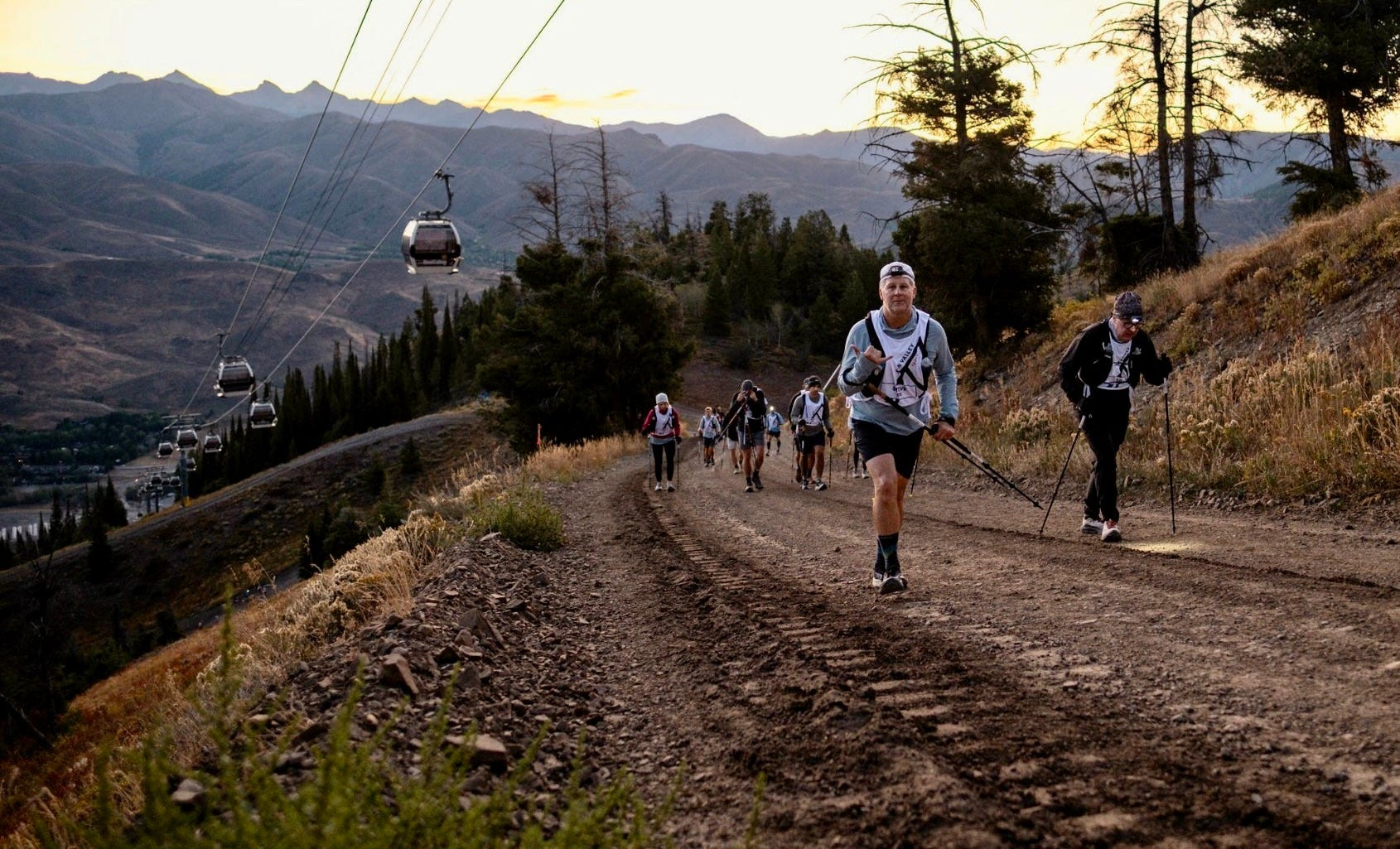
I signed up for 29029 because I wanted to build something I had never built before. That was the whole reason.
I had written a book about how systems hold together and how they come apart. A lot of it is about constraint architecture, the structure that help a system remain coherent under pressure. I wanted to put that thinking to a live test using my own body.
Ironman was my first choice and I felt it was the wrong one. I have done seven Ironmans and dozens of half Ironmans and other triathlons. I know how to build that system. I know what the training looks like, what the long days feel like, and how to fuel a body through a swim, a bike and a run. I wanted a problem I did not already understand.
29029 seemed a suitable challenge for what I wanted. At Sun Valley, 29029 is fifteen trips up Bald Mountain, riding the gondola down after each one, until you have climbed the height of Everest. You have 36 hours. The climbing, duration, fueling, muscular demands and repetition were all different from what I had done before. You do not finish one discipline and move to another. You ride back down and climb the same mountain again.
So I built the system the way I would tell anyone to build one. Understand what you are asking it to do, then build a training plan to accomplish that goal. I trained specifically for the climbing. I built aerobic capacity, worked on strength, practiced fueling and spent a lot of time on my feet. The goal was not simply to become fitter. It was to build a body capable of absorbing a very specific kind of stress over a very long period of time.
I did the work, absorbed it, and showed up physically ready.
Two weeks before the event, I got one piece of information that gave me some pause. My wife and daughter were doing 29029 in Whistler, and I ran into a guy who had already done Sun Valley. His first question was whether I had trained much on really steep hills.
Not really, I told him. I had done some treadmill simulations, but most of my focus had been on climbing volume, time on my feet and durability. Where I live, sustained steep climbing was hard to replicate.
He told me the steepness at Sun Valley had really hurt his Achilles tendons and that it mattered more than he expected. I listened. I did not let one conversation two weeks before the event shake my confidence in months of training, especially when there was little I could do with the information at that point.
He turned out to be right. Not about my Achilles, but about the specificity of the problem.
Before we get to that, I made a mistake almost immediately. The event started in the dark. It was cool, my legs felt good, and the first climb was crowded enough to annoy me. I wanted some clear space, so I started passing people.
Then I kept passing people.
My first three ascents were too fast, and I knew they were too fast while I was doing them.
Nothing had failed in the architecture. I knew the pacing constraint and simply chose not to follow it because the exception felt reasonable.
Fortunately, I do not think it cost me much. But it was a reminder that constraints do not operate themselves. The architecture can be sound and the operator can still make a bad decision inside of it.
By lunch on the first day, the problem was different. I had finished five ascents. The ten still to come were intimidating, but the immediate problem was physical. I was hydrating well but not peeing, and I became convinced something was wrong.
Before the event I had told Brent, my coach, not to hold my hand. Let me struggle. Let me make the decisions. Let me figure it out. That was part of choosing something unfamiliar in the first place.
Instead, by lunch, I was looking to him for help.
“Brent, I feel like shit and I can’t pee.”
Brent brought me watermelon juice and told me not to be in a rush to get back on the mountain. Give the body a chance to reset. So I went to physical therapy, ate some food I did not particularly want, drank the juice and waited. Eventually I peed, felt better, and went back up.
That stop forced me to reckon with something I had gotten wrong before the event even started.
I had been convinced 29029 was not going to be that hard. I remember thinking I would probably need to push late into the evening just to get enough out of it. By lunch on the first day, that picture was already wrong.
It was hard.
That is where humility becomes practical. It is easy to say you might be wrong. It is harder to recognize that the thing happening in real time is different from your expectations. It is even harder to change your behavior accordingly.
The watermelon juice gave me the opportunity to reset around the event I was actually doing rather than the one I had imagined.
Later, the front of my hips began to fatigue and I was dealing with real pain. The repeated lifting of my leg irritated the insertion point of the hip flexor until each step felt like an ice pick being driven into me. Looking back, I probably lacked some of the specific strength and durability that movement required.
I was aerobically ready and had done the climbing work, but the mountain found a local weakness I had not fully accounted for. Once it revealed itself, I had to adapt.
The guy in Whistler had effectively warned me about this. Not the exact body part, but the problem…Sun Valley was steep enough that the repetitive mechanics mattered more than I appreciated.
The mental part was harder.
After the tenth ascent, I wanted off the mountain. I was simply sick and tired of going up. So, I went to bed knowing I had five more climbs to tackle the next day.
The repetition had gotten to me. Up, gondola down, up again. There was no transition to another discipline the way there is in an Ironman. The problem did not change. You returned to the bottom, knowing exactly what came next, and had to decide whether to do it again.
That was probably the biggest gap between the system (my body) I had built and the operator (my mind) who had to run it. I had trained the body well enough. I had not prepared myself for the sameness. I am not sure I knew how, or that I even needed to. I had many moments where I simply thought “this sucks.”
But the architecture was still there, both in what I had built and in the event itself.
The 36-hour window created time to adjust. The gondola removed the accumulated fatigue from the descent. Food, physical therapy and medical support were available. Brent was there when I needed an encouraging word. The event itself was exceptionally coherent. It gave me enough structure that a mistake did not need to become a collapse.
A good system does not guarantee that the operator will make every decision correctly. I went out too fast, misjudged the difficulty, missed a specific physical weakness and underestimated the mental cost of repetition.
But none of those mistakes required me to abandon the system. They required me to recognize what was actually happening, adapt, and keep going.
A coherent constraint architecture is valuable because reality will eventually differ from the plan, and a coherent system allows the operator to adapt without turning every mistake into failure.
Pacing gave me a way to slow down after I started too fast. Humility allowed me to stop defending the event I had imagined and respond to the one that was actually happening. In other words, it allowed me to stop feeling sorry for myself. And the structure of the event itself around me kept those mistakes from becoming something larger.
I went to Sun Valley wanting to know whether I could build a new system using the ideas I had spent 18 months writing about.
I could. The system I built got me to the mountain ready enough, and the architecture held.Now after reflecting on each of those 29,029 feet I climbed, I came away believing in the architecture more, and for this event, that was really the goal.
But I am also grateful to have earned that red hat.
Thank you for reading Wondering Aloud.
Steve Barth, CFA
Wondering Macro LLC