

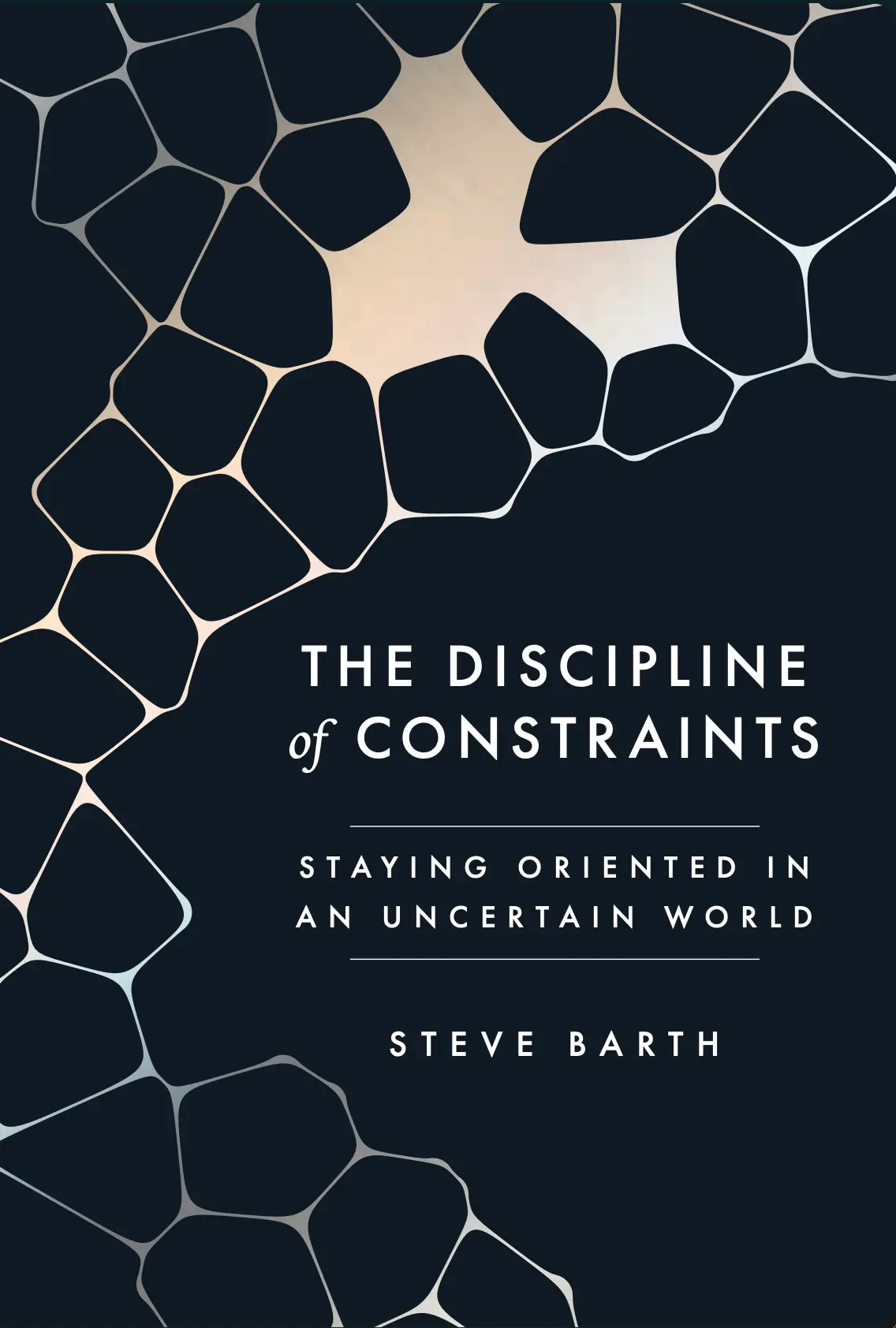
The Discipline of Constraints
Staying Oriented in an Uncertain World
Everything we deal with is a system connected to other systems. A body. A portfolio. A market. Each one has structure that can be read, and each one can drift, endure, or fail depending on what's holding it together.
Most of us feel that drift before we understand it. We can’t always name why something feels wrong around us, or what’s making us feel that something has shifted at work, at home, or in an institution. The answer is structural: we’re experiencing disorientation in the systems we operate within.
This book gives language to the constraints that make up our systems, exploring why some systems endure while others drift and collapse.
It starts with a practitioner's observation – the realization I had that my work training for an Ironman ran on the same architecture I used to build investment portfolios. Once I saw the parallels, I started finding the architecture everywhere, backed by three load-bearing constraints in all systems.
The book walks through how that works across domains: monetary systems, organizations, technology, endurance athletics, and the daily architecture of a life. It offers a framework for asking better questions when certainty is out of reach.
The Discipline of Constraints: Staying Oriented in an Uncertain World is published by Amplify Publishing, arriving January 2027.
Preorder the book →The Framework
For a human-operated system to endure, three load-bearing constraints form a coherent common architecture.
Constraints
A constraint is not a limitation in a negative sense; it’s the architecture that holds all systems together. We remove or change constraints all the time, often for good reasons, but not all constraints carry the same weight. Some are load-bearing. Take one out and the system doesn't just lose a feature – it loses coherence.
Understanding which constraints are load-bearing, and what happens when they're absent, is the core analytical question of constrained systems thinking.

Pacing
The discipline of regulating speed and intensity to ensure sustainable progress. It is how you move through the system at the rate that makes sense.
Pacing, here, is the deliberate rhythm that lets a system keep moving without breaking. Train for a marathon in two weeks and you'll get hurt. Scale a company before the culture can absorb new people and you'll burn through trust. Pacing is intelligence about what a system can absorb over time.

Humility
The practice of accepting reality, resisting false certainty, and navigating uncertainty without illusion. It is how you sense and feel where you are as you move through the system.
Humility is not a moral instruction to be humble; it's an honest reckoning with what you know, what you don't, and where the system actually is, as opposed to where you'd like it to be. In some systems, this capacity lives at the system level. In others, it falls to the operator. A body doesn't have humility. The athlete running it does. When the system can't hold it, the operator has to, and most don't realize that until it's too late.

Friction
The productive role of deliberate limits, struggle, and resistance that foster adaptation and strength. It is how you respond and adapt as you move through the system.
Friction is the most counterintuitive of the three. The word itself sounds like something to be eliminated; that instinct is exactly the problem. Friction is the training plan, the nutrition protocol, the stop-loss, the approval process, or the budget cap. The elements that look like limitations from the outside are what let the system respond and hold together under pressure. Guardrails like a stop-loss on a portfolio can look like a limit on returns – until the market does something nobody predicted, and it's the reason the portfolio survives. Friction is the constraint that can help a system run smoothly.
Who this book is for
I wrote it for anyone navigating complexity and uncertainty, which, as far as I can tell, is everyone: the reader, the operator, the investor, the builder.
Organizations & Leaders
If you run an organization and the ground keeps shifting underneath you, this is a framework for understanding why.
Investors & Managers
If you manage money and the gap between narrative and reality keeps widening, the same framework applies.
Builders & Families
If you're building a business, raising a family, or just trying to make sense of why everything feels harder to read than it used to, the language is the same.
This book offers a structural lens to help you see what's holding your system together, what’s causing drift, and where the load-bearing constraints sit. With practical applications for the systems you operate, lead, and build, The Discipline of Constraints: Staying Oriented in an Uncertain World gives you a language for the disorientation you already feel and a framework for moving through it.
Book resources
The book lays out the framework. The work below puts it into practice.
The Constraint Engine
An analytical tool that pressure-tests a system, scores its coherence, and helps identify which constraints are load-bearing. It is the operational spec behind the research, workshops, and advisory work. More on this after the book launches.
Wondering Aloud
The newsletter where I think through problems in public, applying the framework to markets, AI, institutions, family life, and whatever else I'm wondering about. It arrives twice a month.
Speaking & Advisory
Talks built for the next workday, working sessions that run your system through the Constraint Engine, and ongoing engagements customized to whatever you're building.