
The Inefficiency of Being Human
Someone pointed out to me recently that I seemed to like organic interactions with people much more than planned ones. She said it matter-of-factly and, at first, I thought she was calling me antisocial. When I thought more about it, she was right.
If I run into someone outside a store and we talk for five minutes, that conversation is almost always more interesting to me than the lunch we might have planned for the following Tuesday. The scheduled version would have been fine, wonderful even, but it would have arrived a little pre-shaped. We both would have known why we were there. We might have thought about what we wanted to talk about ahead of time. Some of the uncertainty would already have been removed before we sat down.
The accidental conversation has none of that. Those encounters happen in the space between the things I was supposed to be doing. If I had been more efficient with my time, I might have missed every one of them.
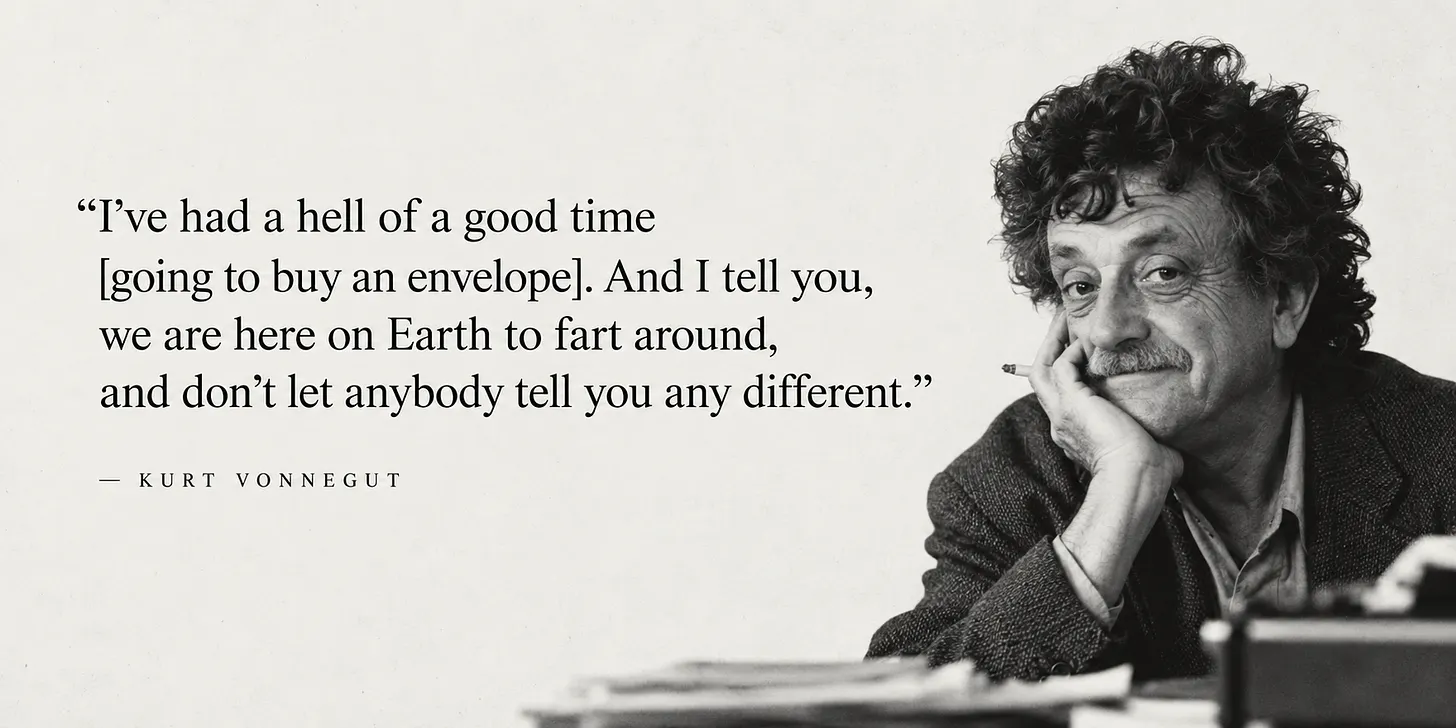
Kurt Vonnegut once talked about how he would go out to buy a single envelope rather than order a box of them and have them delivered. His wife thought it was ridiculous. From the standpoint of acquiring envelopes, of course, she was right. The most efficient version of the task would have been to order a hundred envelopes and wait for them to arrive while doing more meaningful things.
But the way Vonnegut described it, the errand was never really the point. He would walk to the store. He might talk to someone along the way. He might stop and notice something. He might encounter a person he had not expected to see. The trip to get an envelope contained a world of spontaneous experiences that had nothing to do with the stated purpose of the errand.
He called it “farting around.”
The efficient version leaves you with plenty of envelopes. It may also leave you with nothing else.
I like this thought because we live in a culture increasingly interested in optimization. Companies optimize workflows. Investors optimize portfolios. Athletes optimize training. We optimize sleep, nutrition, productivity, travel and, increasingly, ourselves.
There is an important distinction here, because efficiency and optimization are not the same thing.
Efficiency is about getting better at what you do. It is reducing unnecessary effort, cost or waste while preserving the function of the system. Optimization is different. Optimization pushes a system toward the maximum of some chosen objective.
The difference matters because the closer a system gets to that maximum, the more tempting it becomes to eliminate everything that does not appear to contribute directly to it. Redundancy disappears. Spare capacity shrinks. Idle time gets filled.
The problem is that in a complex system, what looks like waste is often slack. And slack is what absorbs uncertainty.
A company keeps spare capacity it hopes it will never need. A portfolio holds cash while markets are rising. A supply chain maintains multiple suppliers instead of concentrating everything with the cheapest one. A person leaves part of the day unscheduled.
Viewed narrowly, these can all look inefficient. Viewed over time, and especially under uncertainty, they may be exactly what allows a system to endure.
That is where optimization becomes dangerous as an objective. Eventually, unused capacity looks wasteful. Redundancy looks excessive. Cash looks unproductive. An empty afternoon looks like time that should have been spent more effectively. The system begins removing slack because the slack is not contributing directly enough to the thing being maximized.
But that slack is where the system stores its ability to respond to something the objective did not anticipate.
At rest, doing nothing and going nowhere, the human body burns roughly a hundred watts of energy. About the same as a lightbulb left on in an empty room. Some of that energy is “unproductive,” but your body is doing enormous amounts of work simply to remain a body. It is maintaining temperature, repairing tissue, circulating blood and preserving the extraordinary organization required to keep you alive.
I call this the entropic tax.
Every system that endures pays one somewhere. Some portion of its resources must be spent maintaining the organization that allows it to persist. From the outside, that cost can look inefficient, but a body that paid no cost to maintain itself would not be more efficient. It would be dead.
The tax often looks unnecessary precisely because its value appears only when something goes wrong.
Spare capacity matters when demand spikes. Cash matters when markets fall. Redundancy matters when one part of a system fails. Open time matters when something happens that you did not anticipate. Until then, all of it can look unnecessary.
This is why I find the current “maxxing” culture interesting. Fitnessmaxxing, sleepmaxxing, looksmaxxing, longevitymaxxing. I do not mean that dismissively. Much of what sits underneath those trends is sensible. Exercise. Sleep better. Pay attention to what you eat. Learn what works.
But the language reveals the objective: maximize. And maximizing requires a decision about what counts, and what doesn’t.
Once that decision happens, everything else begins to get evaluated according to whether it advances the chosen target. A meal becomes macronutrients. Sleep becomes a score. A workout becomes an input into a physiological adaptation model. A walk becomes steps. An afternoon becomes productive or unproductive.
The measurement may be useful. The problem comes when the measured objective becomes the system.
If you see me out on a run or a bike ride, you might notice something strange for someone making this argument. I will probably have a Garmin watch on my left wrist and a WHOOP band on my right. I collect a lot of data.
But there is a distinction that matters to me. I am interested in the data because I am trying to understand the long-term development of my body as a system, not because I need every workout to tell me whether I succeeded that day. I want the long-term record, because it helps me see patterns over months and years. The technology is a tool used during the workout, helping me keep pacing and output consistent with what the session requires. The data is there to help me understand the system. The system is not there to improve the data.
A life is larger than its measurable outputs.
A dinner with friends may do nothing for your nutrition plan and still be good for you. The slow run with no performance objective may do little for your race fitness and quite a lot for why you continue running for another twenty years. The afternoon spent doing nothing may look completely wasted until it produces the thought, relationship or experience you remember for the rest of your life.
I do not think the right response is to try to prove that all of those things are secretly productive. That would simply be another form of optimization. The more important point may be that some things are valuable without needing to justify themselves against the chosen objective at all.
I have spent most of my adult life around systems that reward discipline and efficiency. Endurance athletics. Investing. Business. All three teach you to conserve resources, reduce unnecessary effort and allocate scarce capacity carefully. They also teach you, if you stay around them long enough, that the strongest systems are rarely the ones operating closest to their theoretical maximum. They keep something in reserve because the world does not arrive exactly as modeled.
The system has to absorb surprises, and that ability has a cost. I think we often mistake that cost for inefficiency, then optimize it away.
This is why I draw the distinction between efficiency and optimization. Efficiency can strengthen a system by removing genuine waste. Optimization has a different logic. It keeps pushing toward the chosen objective, which means eventually it begins asking what else can be removed.
Efficiency removes waste. Optimization removes slack. And slack is what allows complex systems to absorb uncertainty.
That does not mean all slack is worth protecting. Sometimes slack really is unproductive and unnecessary. Some meetings should disappear. Some processes are pointless. The difficult part is knowing what you are looking at before you remove it.
The organizational version of this argument is the growth imperative.
“If you are not growing, you are dying” is a common phrase in business. I am not sure it is always true for every organization.
A business that makes steady profit year after year, where the people are engaged and the work is good and the clients are well served; what exactly is wrong with that? Why does it necessarily need to make more next year?
If the answer is simply that growth has become the objective, then the next question should be what the business has to consume in order to achieve it. More leverage? More utilization? More hours? More customers? Less redundancy? Less room for error?
Maybe those things make the business stronger. Maybe they begin consuming the coherence of the business itself. That is where pacing enters the picture for me. A system can move faster than its ability to absorb what it creates.
None of this is a philosophy about slowing down. It is not an argument against efficiency, measurement, growth or ambition. It is an observation about the architecture of systems that have to persist inside uncertainty.
We are here for a very short period of time. Some of the best things that happen to us will never appear as the successful completion of a task. They will arrive sideways, through interruptions, detours, wrong turns, conversations we did not schedule and places we did not intend to go.
Which brings me back to the envelope.
If you define the task narrowly enough, Vonnegut’s behavior is ridiculous. He needs an envelope. The efficient answer is obvious: order a box and save the trip. But buying an envelope was only the narrowest possible description of what he was doing.
He was taking a walk. He was participating in the world around him. He was making himself available to something he could not have planned because he did not yet know it was going to happen.
Optimization could not account for any of that because optimization requires us to define the objective before we begin.
Maybe that is the inefficiency of being human.
Vonnegut went out for an envelope, but the envelope was simply the reason to leave the house.
Thank you for reading Wondering Aloud.
Steve Barth, CFA
Wondering Macro LLC