
What if Alice Never Woke Up?
A recent article in The Free Press about Winnie-the-Pooh reminded me how much I enjoy children’s stories. I gravitated to several when it came to reading my kids bedtime stories. It was the worlds of Dr. Seuss and A.A. Milne that I enjoyed the most. Reading them aloud was almost like a lyrical rollercoaster, as much fun to say as the stories they tell. Those stories formed some of my favorite reading experiences.
But what makes me wonder is what those stories were explaining. Children’s stories teach you something about human behavior with a kind of elegant simplicity a lot of adults have lost the ability to achieve.
Thanks for reading Wondering Aloud! Subscribe for free to receive new posts and support my work.Subscribe
The characters were recognizable. The situations had something real about them. The lessons are embedded subtly.
A child understands an interesting lesson almost immediately. An adult would need a framework, diagram, ten-step approach, or hourlong podcast to make a new idea stick. We grow up and we complicate everything.
Thinking about those stories brought Alice in Wonderland back to mind.
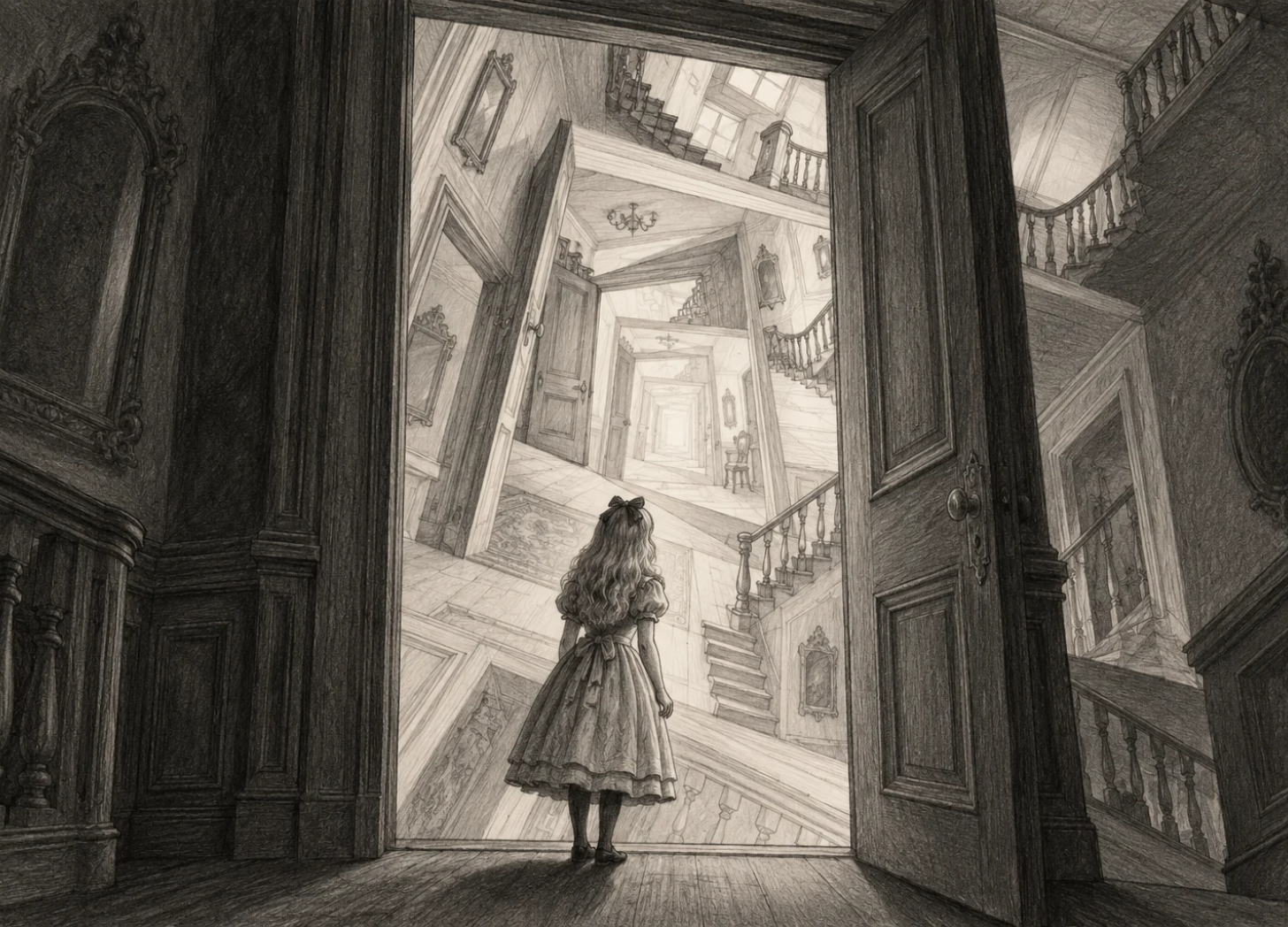
It’s one of those stories that kids love, and that adults should appreciate. In my opinion, Alice’s dream through Wonderland feels like so much of our own modern-day experience. That world was disorienting, much like the disorientation we feel today.
We are not falling or shrinking, but the idea that you could walk through a door and nothing on the other side would work the way you expected is uncannily familiar. I think we can relate to a story like that better than we can to much modern fiction.
It got me wondering about Alice. What if Alice never woke up? What if Carroll did not give her an out and left her in a dream?
I am not sure it would work as a children’s story, but it certainly is an interesting idea.
So, what if the story had no ending and Wonderland was her lived experience?
Let’s explore this as a thought experiment using Carroll’s story, because I think it holds some truths about where my mind focuses…complexity, uncertainty, and orientation.
Consider what Alice encounters in Wonderland. Rules change without warning. The characters she meets contradict themselves and each other. The Queen hands out death sentences for things that were permissible ten minutes earlier, and the Cheshire Cat keeps disappearing.
Alice keeps trying to apply logic to the situation. She expects that, in Wonderland, concepts like authority, language, and time will work the same way they did in her world. If Wonderland has a coherence to its structure, Alice cannot see it.
Of course, none of her understanding holds. Alice becomes increasingly disoriented because nothing she depends on to make sense of the world is reliable anymore.
She has been trying to make Wonderland behave. To find the hidden logic and identify the authority that will eventually set things right. But she cannot find that logic, and there is no authority offering an explanation.
If she had to stay there for good the first thing she’d have to accept is that she can’t make all of this world orderly. Waiting for the system to become understandable would leave her stuck. But accepting everything it demands, every arbitrary rule and shifting standard, would leave her at its mercy.
So the question becomes: what can she establish within this world she can influence?
This is where I think the thought experiment gets especially interesting…at least for me. Alice would have to ask herself the questions I consider structural. What is the system I am inside? Do constraints live in that system, or in my engagement with it? And when the world provides nothing I can depend on, how do I build them myself?
In Wonderland, the constraints that ensure orientation for Alice clearly do not live in the system. The system appears incoherent to her. Nothing external provides the architecture that would keep Alice oriented.
In my way of seeing, she would have to build it on her own, in her engagement with that system.
The burden is transferred. Let’s explore how that might work.
Suppose the Queen of Hearts summons Alice and demands an immediate answer to a question that has no right answer. The court is watching and the Queen’s patience is short.
The old Alice might have scrambled to respond. She might have guessed, hoping to get lucky. But this Alice has learned that urgency imposed by someone else is not the same as urgency that belongs to her. She pauses. She asks a clarifying question. She is pacing herself, moving at a speed for the system and the goal at hand…not to lose her head!
Or imagine Alice meets a creature who explains how Wonderland works. The creature has been here longer and seems to know things. But Alice has learned that confident explanations in this world are rarely reliable. So she treats the creature’s account as probabilistic. She does not dismiss it, but she does not build her next decision on it either.
She is acknowledging that neither she nor anyone else in Wonderland has complete certainty about what comes next.
And then there is the hardest scenario. Imagine the Cheshire Cat offers Alice a shortcut. A way through Wonderland that avoids the Queen’s court, the Mad Hatter’s endless tea party, and the confusion she has encountered.
Alice remembers an earlier conversation with the Cat. When she asked which way she ought to go, he replied, “That depends a good deal on where you want to get to.”
Alice wants to get home. The shortcut might make her journey easier, but she has no reason to believe it will get her any closer to home. So she declines.
The deliberate structure she imposes on herself is about protecting what matters to her. That friction gives her something to hold onto, even when the world around her offers no dependable direction.
I have not handed Alice a framework or a ten-step process and told her to apply it. She encounters problems and works through them, gradually discovering the structure that matters. The architecture she builds is a response to the world she finds herself in.
But building that architecture can come at a cost. When a system provides dependable constraints, the people inside it do not have to construct all of that on their own. The architecture does some of the work for them.
When the system stops providing that, the burden transfers.
In our version of the story, Alice has to furnish her own pacing, her own acknowledgment of uncertainty, and her own productive friction — continuously, from inside a world that offers none of it.
And there is a limit to it. Alice still needs others to buy in. She needs some shared rules, even imperfect ones. Personal discipline cannot compensate for everything the world around her fails to provide.
Back to The Mad Hatter. Perhaps he was once someone who tried to make sense of Wonderland on his own. Maybe the tea party that never ends is what happens when someone tries to impose order without any external architecture to hold it. The effort might lead to madness.
I think a lot of us recognize that feeling.
We make decisions inside systems we did not design and cannot fully control. We are told the world is more connected, more informed, and more capable than it has ever been, yet the experience of navigating it feels less familiar than it used to.
Carroll allowed Alice to wake up, but we don’t get that option.
This is the world we live in. And the question Alice would have had to face is, what do I make reliable in my own life when I cannot make the world around me predictable. This is the same question sitting in front of all of us each day.
It’s not a question with a simple answer. I believe our best option is to build the constraints that keep us grounded to the reality of the world around us.
Alice is a character in a bedtime story. She didn’t have to answer the question again and again.
We do.
Thank you for reading Wondering Aloud.
Steve Barth, CFA
Wondering Macro LLC