
When Change Becomes Drift
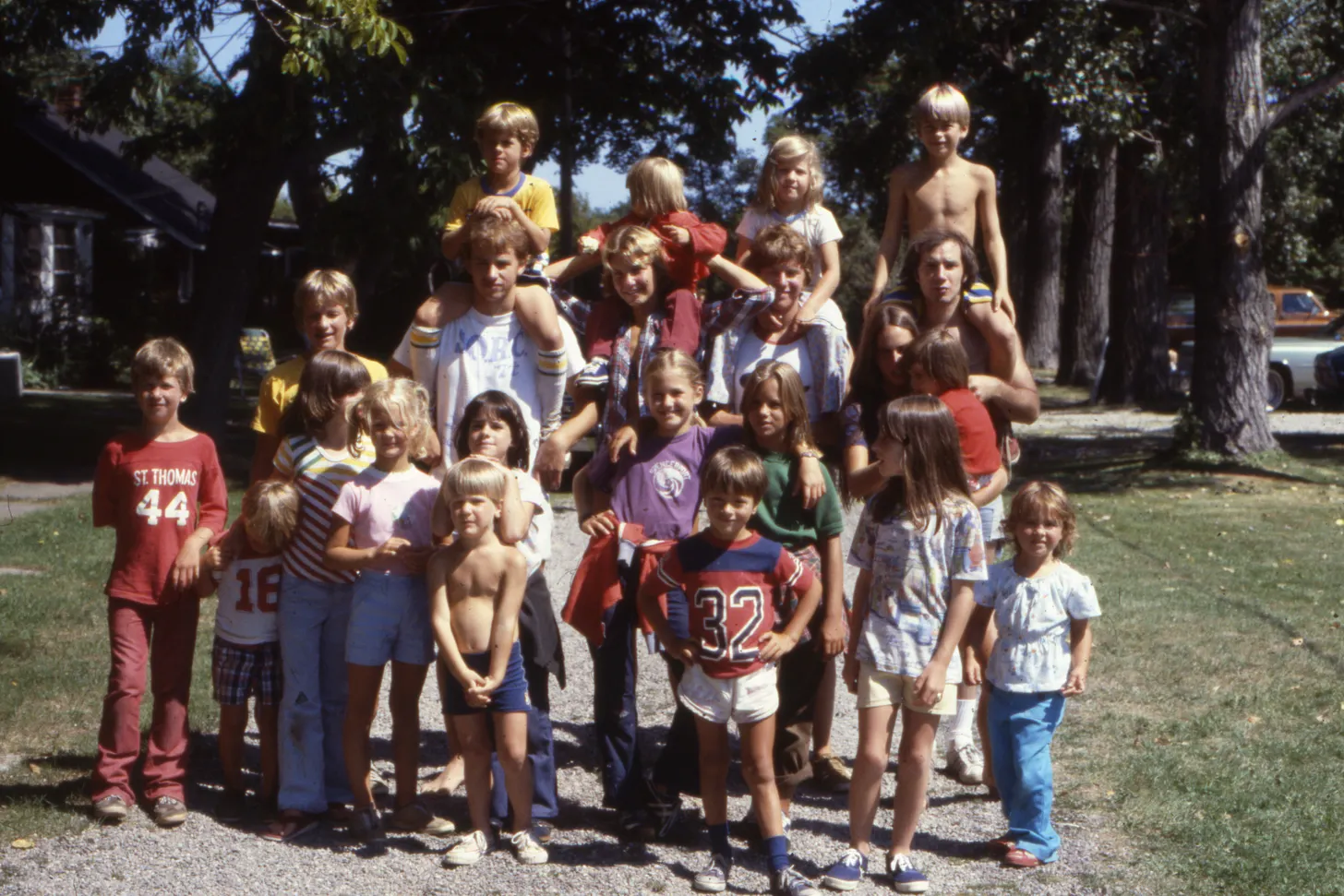
I spent a lot of my childhood summers on the edge of Lake Ontario in western New York. My grandparents and uncle owned several cottages near the water, and it was often where our family would gather. We’d meet up there, catch up, tell stories. After a certain point, most of the family would leave, and my father and I would stay behind for the rest of the summer. There was a lot of time where the cottages went quiet and I was a boy with not much to do.
Lake Ontario is one of the Great Lakes, and if you haven’t been there, it looks more like an ocean than the kind of lake most people picture. Some days the waves roll in hard enough to remind you that the lake has its own weather, but other times, the surface stays still for hours. At least, that’s how it looked to me.
Those were the days I found most interesting.
I would sometimes sit at the end of one of the docks and watch driftwood on those calm days. You could stare at the same piece of wood for five minutes straight, and it would never seem to move. No current you could see. No wind pushing it. Nothing about the scene suggested any motion.
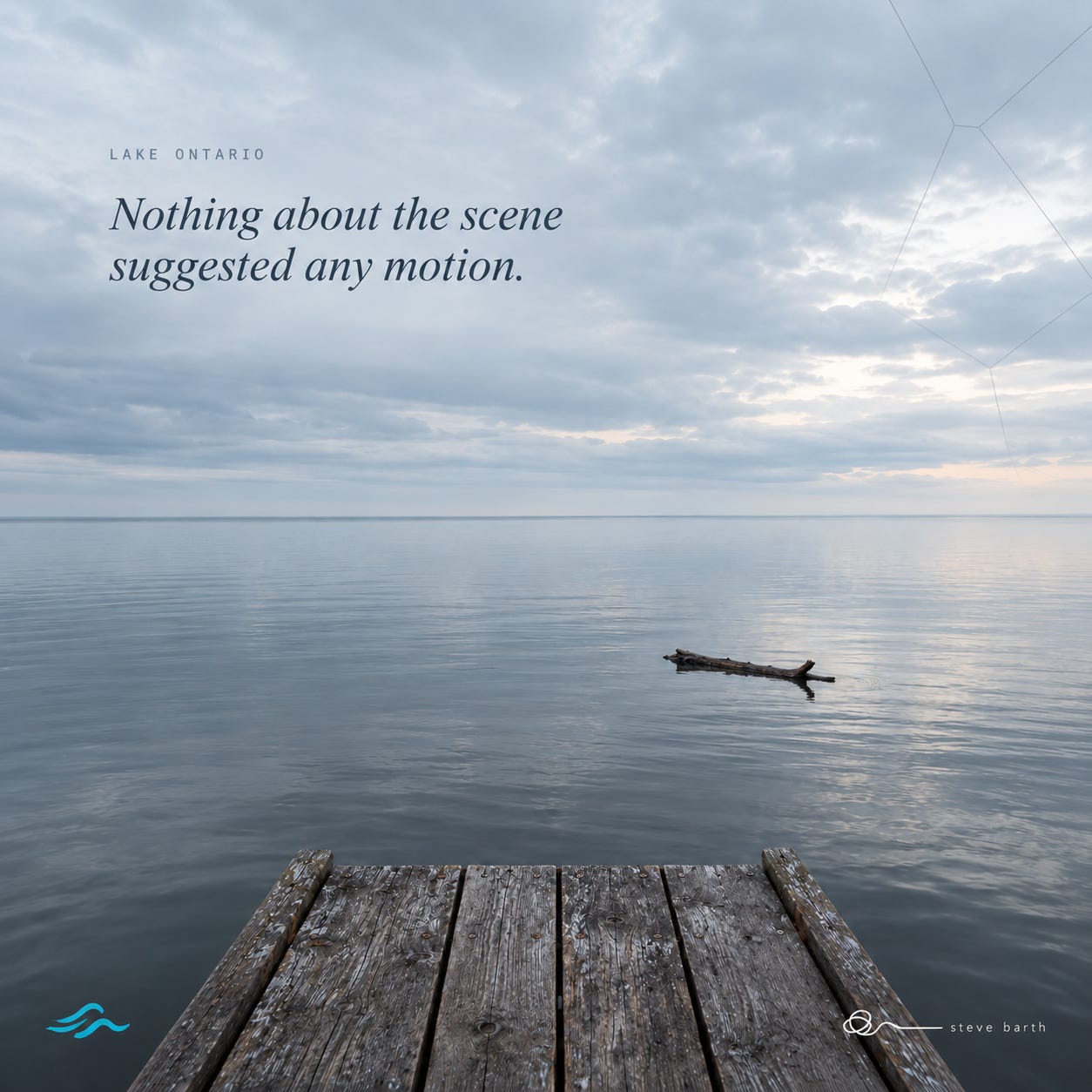
But if you left the dock and came back an hour later, the driftwood had crossed all the way from one dock to the next. I could never catch it in the act. I could only notice, after the fact, that it was no longer where it had been. Whatever was happening was operating below what I could see, at a speed slower than my attention could track.
When I remember these days, I think I had the image slightly wrong for a while, or at least, I was drawing the wrong conclusion from it.
My instinct was to say that drift is the natural state of things. Everything drifts. Systems drift. Organizations drift. We drift. And if everything drifts, then the goal must be to stay oriented while it happens.
But now, I don’t think that’s quite right. There’s a detail I missed, trying to watch the driftwood move.
Complex systems are always in motion. That much is true. They evolve. They adapt. They respond to new information. That’s how systems stay alive. A company that hasn’t changed anything in twenty years is probably not as healthy as it claims to be. A body that trains the same way at fifty as it did at thirty is heading for a breakdown. Evolution is the natural state, and it’s a good thing.
Drift, then, is something else.
I think drift is what happens when a system is evolving, but the constraint architecture that was keeping it coherent is no longer doing its job. The system is still moving and trying to adapt, but the structure underneath has eroded. And nobody noticed because, on the surface, things still look fine.
That distinction matters because a system that is evolving and a system that is in drift can look identical from the inside. Quarterly numbers still come in. The routine still holds. The people still show up. The difference is underneath, in the architecture, and it only reveals itself when conditions change, and there’s nothing left to absorb the shock. Nobody rebuilt the constraints for where the system is now.
It happens in bodies. The runner who used to recover in a day starts needing two, and then three. The training log looks the same and the times look close enough, but the system has shifted underneath. The training plan was written for a body that no longer exists in quite the same form.
It happens in organizations. A company that had a clear sense of who it was starts making small decisions that change its identity. A new product line to capture a different customer. A faster timeline to hit a quarterly number. A process removed because it seemed to slow things down. Each decision makes sense. The people making them are solving real problems. But the architecture that held the system together can change one rational decision at a time.
I think Harley-Davidson is a good example of this.
For decades, Harley kept supply deliberately below demand. If you wanted a new Harley, you put your name on a list and you waited. That constraint created scarcity, the scarcity created a premium, the premium created loyalty, and the loyalty became an identity. It meant something to ride a Harley. There was a system built on a decision to grow at the pace the brand required rather than the pace the market would have tolerated.
Then, gradually, they loosened the constraint. More manufacturing capacity. Expanded lending. Entry-level models for a broader customer base. Every move made financial sense. Nobody at Harley sat down one morning and decided to destroy the brand. The brand evolved through a series of reasonable decisions made by people solving the problems in front of them.
But the constraint they were loosening was doing structural work the spreadsheet couldn’t capture. The waitlist wasn’t a problem to be solved. It was the architecture that made the brand valuable. And they didn’t replace it with anything else. They just let it go.

That’s the part I think is most important. Not that Harley changed…every company changes. But that the constraints changed without anyone rebuilding their architecture for the new reality.
The system evolved. The constraints didn’t evolve with it. That’s drift.
And here’s what makes it so hard to see from the inside.
What does it feel like to be inside a system in drift? Well, to my mind, it doesn’t feel like anything. That’s the problem. Everything appears to be where it was. Except it isn’t. It just looks that way from inside.
This is where the dock comes in, for the driftwood on the lake. I think it’s doing different work than it might seem at first glance.
When I was sitting on the dock as a boy, the dock didn’t stop the water from moving the wood. It couldn’t do that. The dock just sat there, fixed in place. And because it didn’t move, it made the invisible, visible. I could look at the wood, then look back at the dock, and the distance between them told me what I couldn’t track in real time.
But here’s the thing I didn’t understand then. The dock was what kept me oriented while the water moved. Without it, I would have had no way to know the wood was moving at all. The dock didn’t just reveal the drift. It was what enabled my orientation.
I think that’s what constraint architecture does in a system.
Pacing, humility, and friction — the three constraints I keep writing about — don’t prevent a system from moving. They just give the operator something stable enough to maintain orientation as the system evolves.
A pace held deliberately reveals when the system has started to accelerate beyond what it can sustain. Humility — an honest orientation to reality — reveals when the territory has shifted even though the map hasn’t changed. Friction, the productive resistance built into a system’s structure, reveals when the structure is losing shape because it was mistaken for dead weight and removed too freely.
These constraints are the dock. They’re what allow you to tell the difference between a system that is evolving toward something stronger and a system that is drifting toward something more fragile.
But a dock has to be maintained.
Systems evolve, and when they do, the evolution can alter the constraints themselves. A rule that made sense five years ago might not make sense today. A process that held the organization together when it was fifty people might actually be a problem at five hundred.
The constraint isn’t sacred. It might need to be rebuilt for the system as it exists now.
The failure isn’t in removing a constraint. Systems need to adapt. The failure is in removing a constraint without asking whether the work it was doing needs to be done by something else.
Some constraints are load-bearing, and that isn’t always clear until they’re gone. They look like they’re costing you something — time, flexibility, money — and they are. But the cost is doing necessary work. Load-bearing constraints and unnecessary friction can feel identical from the inside. They both look like limitations. They both invite removal. The distinction only reveals itself over time, and by then the architecture has already shifted.
Costco’s markup cap is an example of a constraint that has been maintained. It’s a number that doesn’t adjust to circumstances. Fifteen percent, roughly, on everything. That constraint forces discipline throughout the business. If you can only make so much on the goods, you can’t afford bloated operations or endless complexity. The cap doesn’t prevent Costco from evolving. It’s the dock that keeps Costco oriented as it evolves. When conditions change — when tariffs hit, or when inflation rises — the constraint reveals the change, because the distance between what the cap allows and what the environment demands becomes visible.
In a body, the dock might be a known effort repeated at honest intervals. I swim. The water doesn’t change. It has no interest in what my training plan says I should be capable of. It only responds to what I bring to it today. A fast run on the same route, measured every few months, is stable enough that when the numbers shift, the shift means something the body can’t explain away.
In a portfolio, it might be a written investment policy, or position limits, or a framework that holds regardless of what the market is doing that week. I built my own assessment around a weekly cadence — same rhythm, same criteria, same structure. The cadence doesn’t adjust to accommodate the market’s mood. It’s the dock.
But none of these docks work if you don’t look at them. And none of them work if you let them drift along with everything else.
Harley presumably had strategy documents from the era when they built the waitlist. Those documents didn’t prevent the drift. Someone had to look at the original architecture, then look at the current state, and recognize that the scarcity constraint had been removed in pursuit of volume without anything replacing the structural work it had been doing. . That recognition is the hard part. Most of us would rather adjust the reference point than face how far we’ve traveled.
And the other hard part — maybe the harder part — is rebuilding. When you do see the drift, when you do name the distance, you can’t just go back. You can’t reinstall the old constraints as if nothing changed. The constraints have to be rebuilt for the system you’re in now, not the one you left behind.
The driftwood doesn’t know it’s drifting. It has no reference or dock. It just goes where the water takes it.
We have a choice the driftwood doesn’t. We can build the dock. We can maintain it as the system moves, and rebuild it when the system has evolved past what the old dock can measure. The point is not to keep the system from moving. It is to remain oriented enough to understand what is changing, what should stay, and what needs to be rebuilt.
As a boy, I could not see the driftwood moving. I only knew it had moved because the dock had not. Maybe that is what good constraint architecture does. It gives us something stable enough to notice the change.

Thank you for reading Wondering Aloud.
Steve Barth, CFA
Wondering Macro LLC